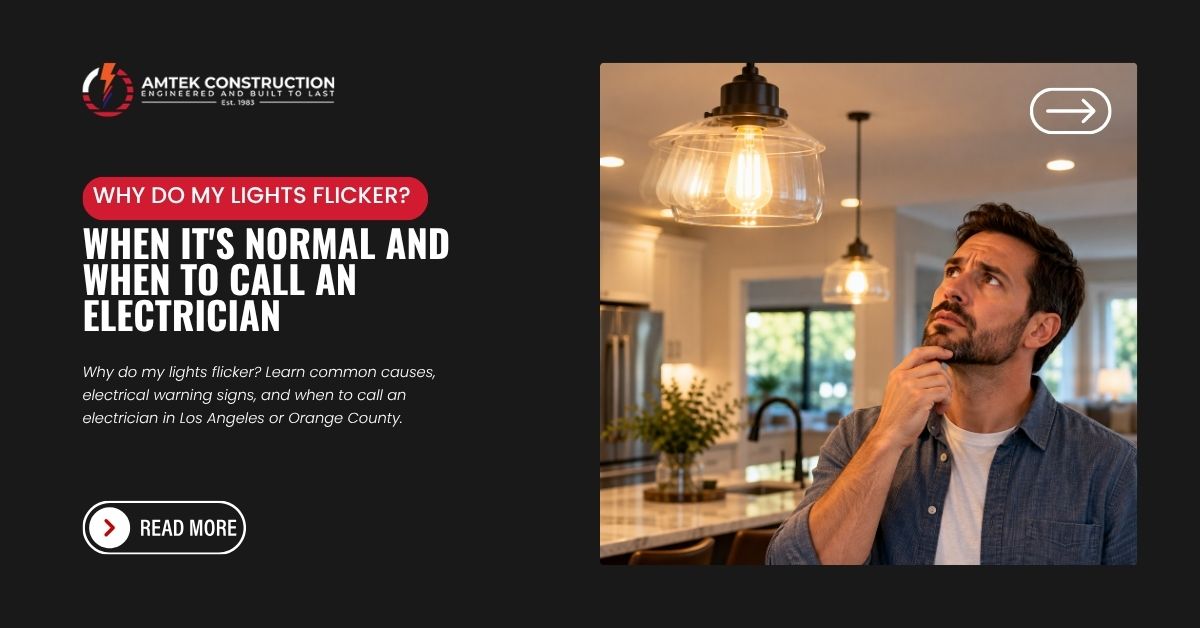
You’re sitting in your living room watching television when the lights suddenly flicker. Maybe it happens when the air conditioner starts. Maybe the kitchen lights dim for a second when you turn on the microwave. Or perhaps you’ve noticed a light that seems to flicker randomly, even when nothing else in the house is running.
It’s easy to ignore a flickering light, especially when it only happens occasionally.
But what does it actually mean?
For homeowners throughout Los Angeles and Orange County, flickering lights are a common electrical concern. Sometimes the explanation is as simple as a loose light bulb or an incompatible dimmer switch. Other times, flickering can indicate a problem with a circuit, electrical connection, or the home’s electrical system.
The challenge is knowing the difference.
Understanding why lights flicker, what warning signs deserve attention, and when to call an electrician can help you address minor annoyances before they turn into larger electrical problems.
Is It Normal for Lights to Flicker Occasionally?
Occasional flickering isn’t always a sign of a serious electrical problem.
For example, some lights may briefly dim when a large motor-driven appliance starts. Air conditioners, refrigerators, and other equipment can create a temporary increase in electrical demand during startup.
A brief voltage change may be noticeable in certain lighting fixtures.
LED lights can also be sensitive to voltage fluctuations or incompatible dimmer switches.
However, repeated or unexplained flickering shouldn’t automatically be considered normal.
The important questions are how often it happens, which lights are affected, and whether other electrical symptoms occur at the same time.
A single light behaving strangely may have a different explanation from multiple rooms suddenly dimming together.
That’s why identifying the pattern matters.
1. A Loose Light Bulb or Fixture Connection
One of the simplest explanations for a flickering light is a bulb that isn’t making reliable contact with its socket.
If only one fixture is affected, the problem may involve the bulb itself, the socket, or an internal fixture connection.
Sometimes replacing a failing bulb resolves the issue.
However, homeowners should be careful not to assume that every flickering fixture has a simple explanation.
If a fixture continues to flicker after the bulb has been replaced, the issue may involve the fixture, switch, wiring, or another electrical component.
If you notice discoloration, unusual heat, buzzing, or a burning smell, stop using the affected fixture and arrange a professional evaluation.
Never attempt to tighten or inspect energized electrical connections.
2. Your LED Bulbs May Not Be Compatible With Your Dimmer Switch
LED lighting has become popular because it offers efficient illumination and a wide range of lighting options.
But not every LED bulb works properly with every dimmer switch.
Some older dimmers were designed for incandescent lighting.
When certain LED bulbs are connected to incompatible dimmers, they may flicker, pulse, buzz, or behave unpredictably at particular brightness settings.
You might notice that the light works normally at full brightness but begins flickering when dimmed.
In some cases, using an appropriate LED-compatible dimmer and compatible bulbs can resolve the problem.
However, flickering can also result from faulty wiring or electrical connections, so compatibility shouldn’t be assumed to be the only cause.
If you’re planning to replace several fixtures or upgrade your home’s lighting, it’s worth having an electrician review the proposed equipment.
Proper lighting installation involves more than choosing fixtures that look attractive.
The controls, wiring, and electrical requirements should also be appropriate for the installation.
3. Your Lights Dim When the Air Conditioner Starts
Southern California homeowners rely heavily on air conditioning during warmer months.
You may notice the lights dim briefly when your air conditioner starts running.
This can happen because the compressor motor draws additional current during startup.
A small, momentary change in lighting brightness may occur without indicating an immediate emergency.
However, noticeable dimming that becomes more frequent, lasts longer, or affects multiple areas of the home deserves attention.
The cause may involve the equipment, the circuit supplying it, voltage conditions, or the home’s electrical infrastructure.
An electrician can evaluate whether the observed behavior is consistent with the system’s normal operation or whether further testing is needed.
If your lights suddenly begin dimming more severely than before, don’t simply assume it’s because the weather is hot.
A change in electrical behavior can be an important clue.
4. Too Many Appliances May Be Sharing a Circuit
Modern homes use electricity in ways that older homes weren’t necessarily designed to support.
Think about a typical kitchen.
You might have a microwave, coffee maker, toaster oven, blender, and air fryer operating throughout the day.
If multiple high-demand appliances are connected to the same circuit, their combined electrical load can create problems.
In some situations, you may notice dimming or other changes when appliances operate.
Overloaded circuits may also cause breakers to trip.
It’s important to understand that flickering alone doesn’t prove a circuit is overloaded.
Loose connections, voltage problems, and other electrical conditions can produce similar symptoms.
A professional evaluation can help identify the actual cause.
For homeowners planning kitchen renovations or additional electrical equipment, reviewing circuit capacity early can prevent avoidable problems.
Adding dedicated circuits where appropriate may help distribute electrical loads more effectively.
5. Loose Electrical Connections Can Cause Flickering
This is one of the more concerning possibilities.
Electrical connections can deteriorate, become damaged, or develop problems over time.
When a connection is unreliable, the electrical supply to a fixture or circuit may become intermittent.
The result can include flickering, dimming, or unexpected interruptions.
A loose connection may also create localized heating or electrical arcing, depending on the circumstances.
These conditions can create a fire hazard.
Warning signs that deserve immediate attention include:
- Flickering accompanied by buzzing or crackling
- Outlets or switches that feel unusually warm
- Burning or melting odors
- Discoloration around electrical devices
- Lights that flicker when a switch or outlet is touched
- Repeated interruptions affecting the same circuit
If you notice smoke, sparks, or signs of active electrical overheating, move away from the affected area and seek emergency assistance when appropriate.
Do not remove outlet covers, open electrical panels, or attempt to repair wiring while it is energized.
Electrical connections should be inspected and repaired by a qualified professional.
6. Your Electrical Panel May Need Attention
The electrical panel distributes electricity throughout your home.
It contains circuit breakers and connections that are essential to the operation of your electrical system.
If flickering affects multiple circuits or occurs alongside other electrical symptoms, the panel may be one of several areas an electrician needs to evaluate.
Possible concerns can include deteriorating connections, damaged components, or problems related to the electrical distribution system.
However, flickering lights do not automatically mean you need a new electrical panel.
That distinction matters.
Sometimes the problem is limited to a particular circuit or fixture.
In other cases, an evaluation may reveal that the electrical panel or service equipment needs repair or replacement.
AMTEK Construction provides residential electrical panel upgrades in Los Angeles and Orange County for homeowners whose existing electrical infrastructure requires improvement.
The right recommendation should be based on the condition of the equipment and the results of a professional evaluation, not simply the age of the home.
7. Flickering Throughout the House May Indicate a Service Problem
When lights flicker in several rooms at the same time, the issue may extend beyond an individual fixture.
Possible causes include problems with the home’s electrical service, connections, or voltage supplied to the property.
A particularly concerning symptom is when some lights become unusually bright while others dim.
This can indicate a neutral connection problem or another serious electrical condition.
Voltage abnormalities can damage appliances and electronic equipment and may create safety hazards.
If you notice widespread flickering, especially when accompanied by unusually bright lights, burning odors, or other concerning symptoms, stop using affected equipment and seek prompt professional assistance.
Depending on the situation, the utility company may also need to investigate the incoming electrical supply.
An electrician can help determine whether the problem appears to originate within the home’s electrical system or requires utility involvement.
8. Older Homes May Have Wiring That Needs Evaluation
Los Angeles and Orange County have many beautiful homes that were built decades ago.
Older homes can offer distinctive architecture, established neighborhoods, and features that homeowners appreciate.
But their electrical systems may have experienced years of changes.
Previous owners may have remodeled kitchens, added appliances, converted garages, or installed new lighting.
Some modifications may have been completed professionally, while others may deserve closer examination.
Over time, wiring and electrical connections can also experience deterioration or damage.
That doesn’t mean every older home requires complete rewiring.
It means unexplained electrical symptoms should be evaluated rather than ignored.
Working with experienced electrical contractors Orange County homeowners can trust is especially important when dealing with older wiring, recurring flickering lights, or unexplained electrical problems. A professional inspection can help identify the cause before recommending repairs or upgrades.
AMTEK Construction offers residential electrical inspections in Los Angeles and Orange County to help homeowners understand the condition of their electrical systems.
An inspection can help identify visible concerns and determine whether additional diagnostic testing is appropriate.
9. Problems With the Utility Supply Can Affect Your Lights
Not every flickering light originates inside your home.
Voltage disturbances can also occur on the utility distribution system.
Nearby electrical faults, utility equipment problems, or other supply-related conditions may affect lighting.
Sometimes neighbors experience similar symptoms.
If flickering affects the entire property, it may be worth checking whether nearby homes are experiencing the same issue and contacting the utility company.
However, don’t assume a utility problem is responsible simply because several lights are affected.
Electrical service connections and other components on the property can also create widespread symptoms.
A qualified electrician can evaluate the home’s electrical system and help determine the appropriate next steps.
When Is Flickering Normal, and When Is It Dangerous?
The following situations can help homeowners understand when further attention may be needed.
Flickering That May Have a Simple Explanation
A single LED bulb flickers only when dimmed.
One bulb begins flickering and stops after it is replaced.
Lights briefly dim when a large appliance starts, with no other symptoms.
These situations may have relatively straightforward explanations, although persistent or worsening behavior still deserves evaluation.
Flickering That Should Be Checked by an Electrician
Lights flicker repeatedly without an obvious cause.
Several fixtures on the same circuit behave unpredictably.
Flickering occurs when appliances operate.
The problem continues after bulbs and compatible controls have been checked.
The flickering becomes more frequent or noticeable over time.
Flickering That May Require Urgent Attention
Lights suddenly become unusually bright or dim throughout the home.
Flickering occurs alongside burning smells, smoke, sparks, or unusual heat.
You hear crackling or arcing sounds near electrical equipment.
Electrical devices show signs of melting or damage.
Multiple circuits lose power or behave unpredictably.
These symptoms may indicate dangerous electrical conditions and should not be ignored.
Can Flickering Lights Cause an Electrical Fire?
Flickering itself doesn’t cause an electrical fire.
However, some of the electrical conditions responsible for flickering can create fire hazards.
For example, a deteriorating electrical connection may generate excessive heat or arcing.
If left unaddressed, that condition can damage electrical components and surrounding materials.
This is why the underlying cause matters more than the visible symptom.
A flickering LED caused by dimmer incompatibility is very different from flickering caused by a damaged electrical connection.
Homeowners should avoid assuming the cause without appropriate evaluation.
How Does an Electrician Diagnose Flickering Lights?
An electrician typically begins by asking questions about when and where the flickering occurs.
Does it affect one fixture or several rooms?
Does it happen when the air conditioner starts?
Does it occur only when certain appliances are operating?
Has the problem become worse?
These details help narrow down possible causes.
Depending on the symptoms, the electrician may evaluate lighting fixtures, switches, circuits, electrical connections, the panel, and relevant voltage conditions.
Diagnostic testing may help identify irregularities that aren’t obvious during a visual inspection.
The goal is to determine why the flickering occurs before recommending repairs.
Sometimes the solution is relatively simple.
Other situations may require electrical repairs, circuit modifications, or additional investigation.
Should You Replace Your Electrical Panel Because Your Lights Flicker?
Not necessarily.
An electrical panel replacement is a significant improvement and should be recommended for a valid reason.
Flickering lights alone do not establish that the panel needs replacement.
The cause may involve an individual fixture, dimmer switch, branch circuit, service connection, or utility supply.
However, if an inspection identifies damaged panel components, unsafe conditions, or inadequate capacity for planned electrical improvements, an upgrade may be appropriate.
Whether you’re searching for electrical contractors in Los Angeles or electrical contractors Orange County, choosing an experienced electrical contractor matters. AMTEK Construction evaluates the complete electrical system to help determine whether the problem requires a simple repair, additional troubleshooting, or a more substantial electrical upgrade.
Can New LED Lighting Help Stop Flickering?
Sometimes.
If the flickering is caused by a failing bulb or incompatibility between LED fixtures and dimmers, selecting appropriate lighting equipment may solve the problem.
However, installing new LED lights will not correct damaged wiring, poor electrical connections, or service voltage problems.
This is an important distinction for homeowners remodeling their kitchens, bathrooms, or living spaces.
Lighting upgrades should be coordinated with the condition of the existing electrical system.
The same principle applies to commercial properties.
Office buildings, retail stores, warehouses, and other facilities may experience lighting problems related to outdated fixtures, incompatible controls, or electrical system concerns.
For businesses considering larger lighting improvements, AMTEK Construction also provides commercial LED lighting installation and upgrades in Los Angeles and Orange County.
A commercial lighting evaluation can help determine whether existing fixtures, controls, or related electrical infrastructure should be improved.
Frequently Asked Questions About Flickering Lights
Why do my lights flicker when the air conditioner turns on?
Air conditioners can draw substantial current during startup, sometimes causing a brief voltage change. Persistent, severe, or worsening dimming should be evaluated by an electrician.
Is it dangerous if only one light flickers?
Not always. The problem may involve the bulb, fixture, or dimmer. However, continued flickering, buzzing, unusual heat, or burning odors can indicate a more serious concern.
Why do my LED lights flicker even though they’re new?
Possible causes include incompatible dimmer switches, LED driver problems, electrical connections, or voltage irregularities.
Can a bad breaker cause lights to flicker?
A defective breaker or associated connection may contribute to electrical problems, but flickering can have many other causes. Proper testing is needed to identify the source.
Why do my lights flicker when I use the microwave?
Starting or operating an appliance can affect electrical loads. Repeated or pronounced flickering may indicate a circuit or voltage issue that needs evaluation.
Should I call an electrician if all my lights flicker?
Yes. Widespread flickering deserves prompt investigation because it may involve the electrical service, neutral connections, or utility supply.
Can flickering lights damage appliances?
The flickering itself is not necessarily damaging, but underlying voltage problems can affect appliances and sensitive electronics.
Do flickering lights mean my house needs rewiring?
Not automatically. Rewiring is only appropriate when the condition of the existing wiring and the results of an evaluation justify it.
Don’t Ignore Changes in Your Home’s Electrical System
Your home’s lighting can provide clues about what’s happening behind the walls.
A single flickering bulb may be a minor inconvenience.
But repeated flickering, unusual dimming, buzzing, overheating, or changes affecting multiple rooms can indicate an electrical problem that deserves professional attention.
The most important thing is not to guess.
For homeowners in Los Angeles and Orange County, understanding the cause of flickering lights can help prevent unnecessary repairs while ensuring potentially dangerous conditions aren’t overlooked.
AMTEK Construction helps residential property owners evaluate electrical concerns, inspect existing systems, troubleshoot problems, and plan appropriate electrical improvements.
If your lights are flickering and you’re unsure why, it’s worth having the electrical system checked before the problem becomes more serious.
Contact AMTEK Construction to discuss your electrical concerns and schedule a professional evaluation.